
Emily Midkiff’s Article on The Tea Dragon Society

In her 2025 article, “Cozy Fantasy and Queer Ecology in Kay O’Neill’s Tea Dragon Books,” scholar Emily Midkiff argues that the Tea Dragon trilogy can “demonstrate how the relatively new cozy fantasy trend is particularly well suited to the goals of queer ecofeminism and queer ecology.” #teadragonsociety 1/9


“Cozy fantasy that features diverse characters in a natural setting is itself a challenge to the exclusivist rhetoric of who belongs in nature, while the cozy fantasy plot also challenges the idea that nature—or fantasy—is a proving ground for the straight white man.” She then applies this to TDS: 5/9

“Children’s books often only feature one or two of the identities and themes featured in this series, but O’Neill combines depictions of disabled characters, queer characters, and BIPOC characters in a natural setting to resist traditional depictions of nonnormative identities as antithetical to natural spaces.” 6/9
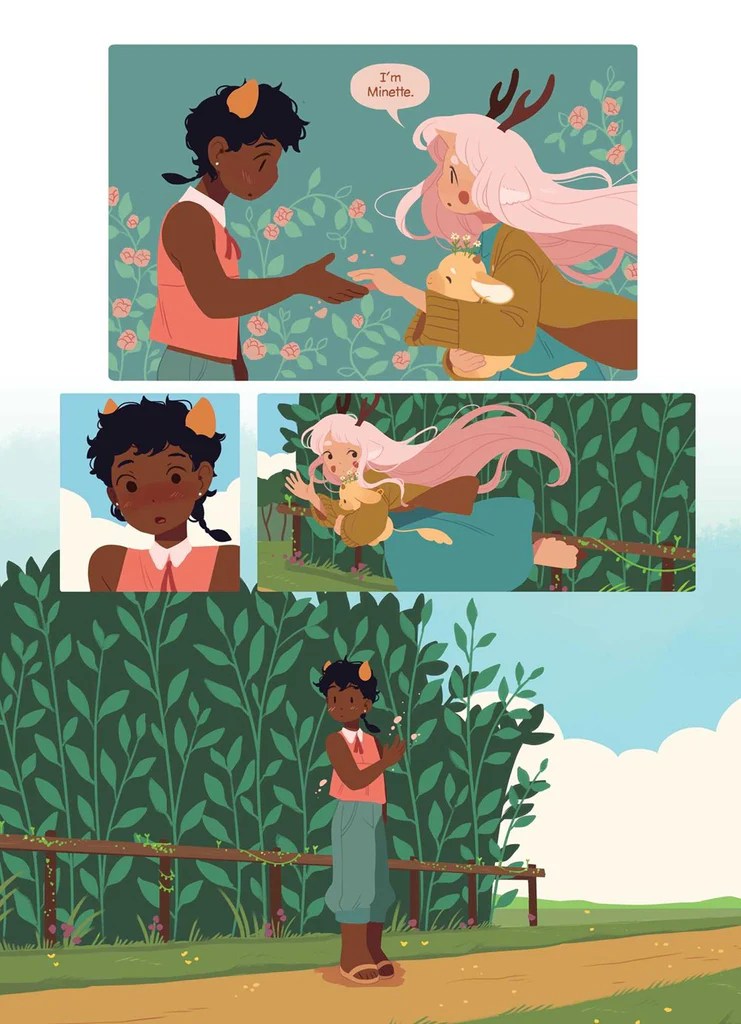
This includes the main characters, each of whom have some aspect of monstrosity to them: “Greta and Minette are in one way monstrous by being literal monsters, and in another monstrous by being queer, female, and, in Greta’s case, brown-skinned.” 7/9

Indeed, Midkiff’s reading is thoroughly multi-faceted, exploring the visual aesthetic, character dynamics, and, especially, the symbolic vocabulary employed by O’Neill, all coalescing to form a deeply compelling argument on how O’Neill’s work fits a queer ecology reading. 8/9

Midkiff concludes with a hopeful outlook. “The cozy fantasy’s ability to frame radical ideas as comfortable and safe makes space for readers to enjoy this queer alternative fantasy space and for young readers to imagine cozy queer futures.” 9/9