Gender in “Green Lantern/Green Arrow”

Dennis O’Neil & Neal Adams’ “Green Lantern/Green Arrow” is rightly remembered as admirably ambitious & frustratingly flawed. Its treatment of gender politics is emblematic of this duality, showcasing both revolutionary & traditional attitudes within some passionate but perplexing allegories. 1/13

In “Green Lantern/Green Arrow,” an emphasis on confronting social problems at home rather than punching aliens in space challenges superhero comics’ typical veneration of manly violence. Yet the series also strongly associates righteous heroism with very traditional forms of virile masculinity. 2/13

Case in point, in the epilogue of the storyline’s first issue, Green Arrow berates Hal Jordan’s blind loyalty to the Guardians by saying he’s a puppet and therefore not a man and certainly not a hero. The subsequent roadtrip then becomes, in part, an attempt to recapture authentic manhood. 3/13

Hal makes a pact to use his superpowers as seldom as possible and is further forced to become less reliant on his power ring when the Guardians’ punitively reduce its power. The ring initially fails Hal in a tellingly phallic fashion. He’s saved by Oliver’s more dependably virile arrows. 4/13

Later, Hal refers to the power ring as a “mother hen” whose protection he’s relied on to the detriment of his independence–and his implied manhood, given the symbolic feminization of the ring. He then revels in the opportunity to “prove himself” through punches, re-learning “self-reliance.” 5/13

There’s nothing inherently wrong with self-reliance. But it’s worth noting that associating it with the capacity for violence is a very traditional, even-old fashioned stereotype of masculinity, as memorably articulated in Teddy Roosevelt’s 1899 speech on the manly virtues of “Strenuous Life.” 6/13

The series’ depiction of Black Canary is similarly caught between traditional stereotypes & more progressive possibilities. O’Neil & Adams underscore Black Canary’s sexual independence and unconventional (for the time) physicality, showing & telling us that this woman can take care of herself. 7/13

But virtually every time Black Canary demonstrates her physical might, she’s overwhelmed by her (male) attackers and must be saved by her sometime boyfriend and his male accomplice. She thus finds herself in a very traditional feminine role, as an innocent victim who inspires masculine heroism. 8/13
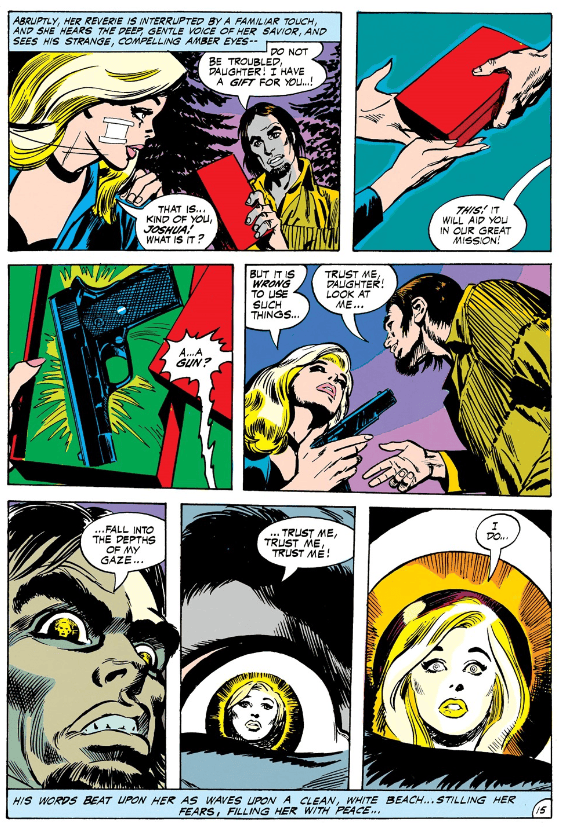
Black Canary’s first appearance in the series further underscores how easily her seeming liberation can be undone by the influence of powerful men. She’s introduced fighting a motorcycle gang but within a few pages, she’s been hypnotized into serving the male leader of a white supremacist cult. 9/13

One of the series’ direct engagement with feminism is an allegorical story in Green Lantern #81. In this story, the protagonists visit a dangerously overpopulated alien planet. A lack of resources makes disparity & deprivation run rampant and pregnant women are shunned as social burdens. 10/13

As the plot unfolds, we learn that a form of cosmic dust led to temporary planet-wide infertility. A character called Mother Juna devised a scientific solution, creating test tube babies who grow to maturity in a matter of days. But she creates too many babies and refuses to slow production. 11/13

In the end, Mother Juna blames her sexist society: she didn’t think she had value unless she became a mother & was driven mad by her relentless pursuit of that value. It’s a potentially powerful critique of how patriarchal societies both celebrate & blame mothers for a variety of social ills. 12/13

But beyond alluding to sexism in a single set of speech bubbles, the comic doesn’t explore any contemporary debates about contraception or motherhood, and only Black Canary seems affected by Mother Juna’s story, in a notably passive way: pleading with Green Arrow to be kind and gentle. 13/13